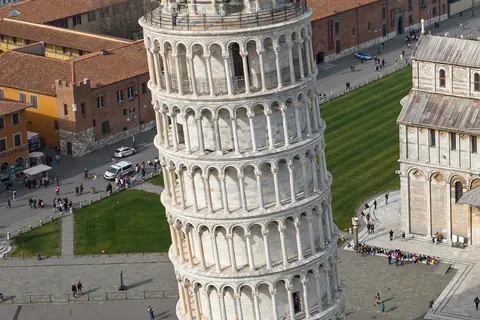
The Leaning Tower of Pisa, or simply the Tower of Pisa, is the campanile, or freestanding bell tower, of Pisa Cathedral. It is known for its nearly four-degree lean, the result of an unstable foundation. The tower is one of three structures in Pisa’s Cathedral Square, which includes the cathedral and Pisa Baptistry. Over time, the flawed tower has become one of the most visited tourist attractions in the world as well as an architectural icon of Italy, receiving over 5 million visitors each year.
The height of the tower is 55.86 metres from the ground on the low side and 56.67 m on the high side. The width of the walls at the base is 2.44 m. Its weight is estimated at 14,500 tonnes. The tower has 296 or 294 steps; the seventh floor has two fewer steps on the north-facing staircase.
The tower began to lean during construction in the 12th century, due to soft ground which could not properly support the structure’s weight. It worsened through the completion of construction in the 14th century. By 1990, the tilt had reached 5.5 degrees. The structure was stabilized by remedial work between 1993 and 2001, which reduced the tilt to 3.97 degrees.
Sources
Text: introduction of the Wikipedia article Leaning Tower of Pisa, under the CC BY-SA 4.0 licence (authors: article history). Facts: Wikidata (CC0). Coordinates: Wikidata, map background © OpenStreetMap contributors.